On 22 November, the MUFPP hosted the first webinar in a series exploring the MUFPP Framework for Action with cities across North and Central America. The session focused on governance, highlighting the institutional arrangements, partnerships and coordination mechanisms that enable cities to develop and implement effective urban food policies.
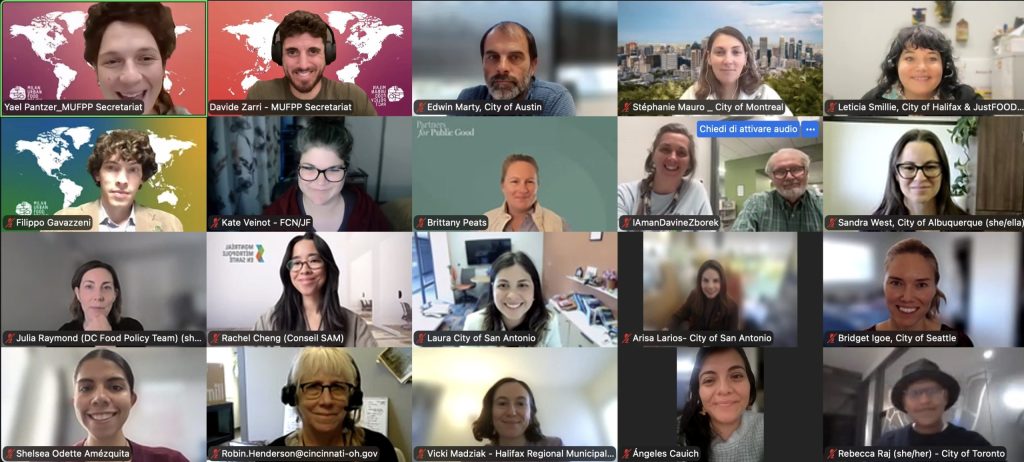
Following an introduction by the MUFPP Secretariat, representatives from Austin (United States), Halifax and Montréal (Canada) shared their experiences and approaches, offering insights into how local governments can strengthen food governance and foster collaboration across institutions, communities and different levels of government.
Austin: Connecting municipal and regional food governance
Edwin Marty, Food Policy Manager at Austin Climate Action & Resilience, presented Austin’s approach to food governance, which connects policy advice, implementation and regional collaboration across the City of Austin, Travis County and Central Texas.
Austin received the Milan Pact Awards 2025 for Governance for its Austin/Travis County Food Plan, a community-driven roadmap jointly developed by the City of Austin and Travis County. The plan outlines 61 strategies across 9 goals to advance a more equitable, climate-resilient and locally rooted food system. Recognized for placing community voices at the centre of decision-making and aligning action across jurisdictions, it translates shared priorities into practical measures to improve food access, support local farms, reduce food waste and create economic opportunities.
Three complementary structures support this governance framework, each playing a distinct role.
– Established in 2008, the Austin-Travis County Food Policy Board advises Austin City Council and the Travis County Commissioners on food-related issues, including access to safe, nutritious, affordable and local food, health disparities, food justice, sustainable production and emergency food distribution.
– The Food Plan Implementation Collaborative supports the implementation of the 2024 Food Plan, bringing together community, city and county representatives, as well as academic and other partners. Its work is organized around five areas: Grow Local; Buy & Serve Better; Get Food to People; Support Workers; and Rescue & Reuse. A liaison with the Food Policy Board helps connect implementation efforts with policy advice.
– At the regional level, the Central Texas Food System Council, launched by the Central Texas Food Bank in October 2025, brings together stakeholders from across 21 counties. It addresses broader challenges related to food production, supply infrastructure and access to healthy food, while promoting shared data, advocacy and mutual learning.
Together, these structures demonstrate how different governance bodies can work in a complementary way, connecting policy guidance, implementation and regional cooperation.
Halifax: Building on existing networks
Leticia Smillie, Food Policy Strategist for Food Security & Systems in Community Safety, presented JustFOOD Halifax Action Plan and the network-based approach developed to support its implementation.
Covering urban, suburban, rural and remote communities, Halifax Regional Municipality operates within an institutional context where key responsibilities, including public health, education and income support, fall under provincial government jurisdiction. This makes collaboration across institutions and communities particularly important.
Rather than establishing a new formal food policy council, Halifax opted for an approach focused on strengthening and connecting existing initiatives. The JustFOOD Halifax Network, soft-launched in June 2026, brings together three founding partners: Nova Scotia Public Health, Ecology Action Centre and the Municipality. The network aims to align ongoing efforts, mobilize resources and support the implementation of the Action Plan. Its activities include convening community partners, developing working groups, expanding the Virtual Food Hub, sharing information and experiences through the Feeding the Movement newsletter, and contributing to provincial food advocacy.
Within this framework, the Municipality acts as a champion, co-lead and seed funder, helping connect municipal responsibilities with community-led action. Its work includes supporting food programmes and coordinators, building capacity for urban agriculture, strengthening emergency food planning, addressing gaps in community food distribution and mapping critical infrastructure and partners.
The presentation also highlighted some of the challenges involved in this approach: making the value of coordination and capacity-building visible, navigating the gap between institutional authority and responsibility, and pursuing long-term systems change while responding to urgent food needs all require sustained commitment.
Community input is at the heart of the Action Plan, while co-ownership, trust, flexibility, diverse partnerships and persistence were identified as essential conditions for progress.
Montréal: Coordinating across mandates and levels of government
Anne Marie Aubert, Coordinator of the Conseil du système alimentaire montréalais (Conseil SAM), and Stéphanie Mauro, Planning Advisor in the City of Montréal‘s Diversity and Social Inclusion Department, presented a governance model connecting municipal departments, a regional food policy council and a broad network of public, community and social-economy organizations.
Like many cities, Montréal faces a recurring governance challenge: local governments are often on the front line of food insecurity and other food-system issues, but do not necessarily have the legal authority or resources to address their root causes. Responsibilities are distributed across federal, provincial and municipal levels, including the City’s 19 boroughs and independent municipalities in the wider metropolitan area.
In response, the City focuses on coordinating action within the areas where it has a mandate and expertise. Examples include its Urban Agriculture Strategy, initiatives addressing food waste and food-safety inspections, and an agreement with Québec’s Ministry of Agriculture to support economic development in the food sector. An internal interdepartmental committee helps align municipal action, while partnerships with external organizations enable complementary work beyond the City’s direct remit.
A key role in this governance ecosystem is played by Conseil SAM, launched in 2018 as part of Montréal-Métropole en santé. Connecting more than 200 partners across the food system, it provides regional leadership through cooperation, knowledge-sharing, policy development and support for transformative initiatives.
The Guichet unique pour la transition alimentaire (GUTA), developed through collaboration between the City and Conseil SAM, was presented as an example of how these partnerships can translate into concrete action. The speakers also introduced the Integrated Regional Action Plan 2026–2030, developed through a participatory process involving food-system stakeholders and 28 events. The plan identifies five priority areas: food insecurity, local food, ecological transition, school food and food citizenship. It provides a shared framework for coordinating efforts and advancing the regional food system transition.
Strengthening food governance through collaboration
The experiences of Austin, Halifax and Montréal demonstrate that there is no single model for effective urban food governance. Whether through dedicated policy boards and implementation collaboratives, networks built around existing organizations, or coordination mechanisms linking municipal and regional partners, each city has developed structures suited to its own institutional context and priorities.
Yet, some common lessons emerge: the importance of building strong partnerships, connecting different levels of government, involving communities in decision-making and ensuring that strategic plans translate into coordinated action.
The webinar offered an opportunity for cities to learn from one another and reflect on how governance mechanisms can support more inclusive, resilient and sustainable urban food systems. By sharing experiences and approaches, cities can strengthen their capacity to address complex food-system challenges and turn shared priorities into meaningful local action.